
Game On!
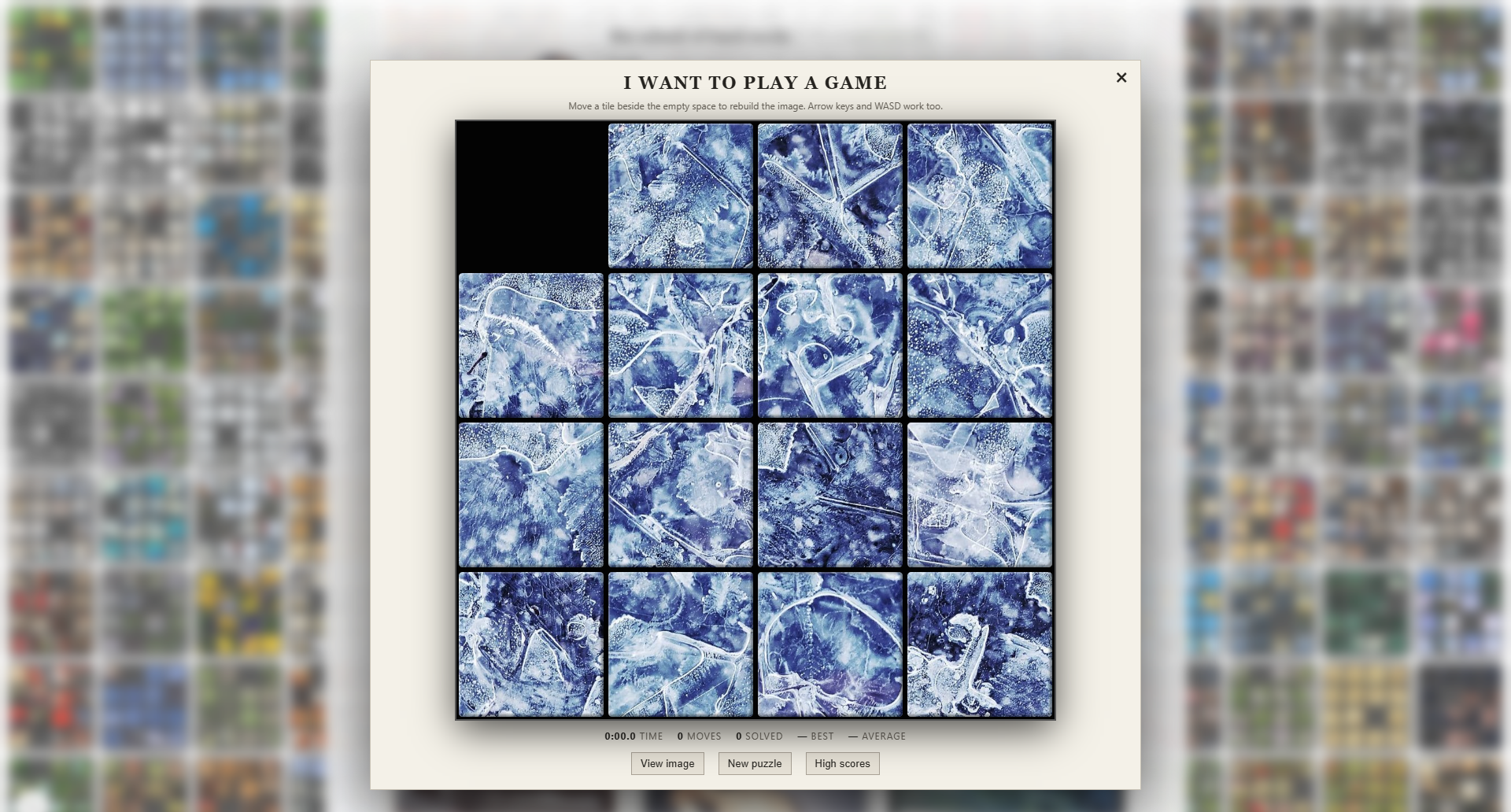
HOW TO PLAY 15 PUZZLE
The picture has been divided into fifteen movable tiles and one empty space. Your job is to rebuild the photograph.
THE ONE RULE
A tile can move only when it is directly beside the empty space.
Click or tap that tile and it will slide into the gap. On a keyboard, you can also use the arrow keys or W, A, S and D.
Diagonal moves are not allowed. Tiles cannot jump over one another. The empty space is not a missing piece—it is how you move every other piece around the board.
WHERE DO I START?
Don’t try to solve the entire photograph at once.
Start with the top row:
- Find the piece that belongs in the upper-left corner.
- Move it toward that corner.
- Place the next piece beside it.
- Continue until the first row is complete.
Then solve the second row the same way. Once the first two rows are correct, concentrate on the remaining two rows.
The final few pieces are usually the hardest. You may need to move something temporarily out of place to create room. That is normal. Sliding puzzles often require you to move away from the apparent solution before you can move toward it again.
Look for lines, corners, recognizable objects and changes in colour. These are usually easier to follow than the photograph as a whole.
NEED A LOOK?
Choose View image to see the completed photograph for two seconds.
The puzzle will arrange itself into the finished image and then return to exactly the state you left it in. The clock continues running while you look, so the preview helps—but it is not free.
ARE ALL OF THESE PUZZLES SOLVABLE?
Yes.
A completely random arrangement of fifteen tiles is not necessarily solvable. In fact, only half of all possible arrangements can be reached through legal moves.
GAME ON never creates a puzzle by throwing the pieces into arbitrary positions. It begins with the completed photograph and scrambles it through a sequence of legal slides. That guarantees there is always a route back to the finished image.
It may be difficult. It is not impossible.
WHEN YOU SOLVE ONE
When the last tile reaches its proper position, the gaps disappear and the complete photograph is revealed. The image pulses twice, then a new puzzle arrives.
During your visit, GAME ON records:
- Your elapsed time
- Your number of moves
- The number of puzzles you have solved
- Your fastest solve
- Your average solving time
You can also submit three initials to the high-score board, in the proud tradition of old arcade machines.
A BRIEF HISTORY OF THE GAME
The 15 puzzle is a 4×4 sliding puzzle containing fifteen numbered tiles and one empty position. It has also been called the Gem Puzzle, Boss Puzzle, Game of Fifteen and Mystic Square.
The puzzle is generally credited to Noyes Palmer Chapman, a postmaster from Canastota, New York, who was showing an early version by 1874. Manufactured copies appeared in the late 1870s, and the game became a major American craze in 1880.
Puzzle maker Sam Loyd later claimed to have invented it, although he was not involved in its creation or its original popularity. Loyd famously offered a $1,000 prize for solving a version in which tiles 14 and 15 had been exchanged.
The prize was safe: that arrangement was mathematically impossible.
William Woolsey Johnson and William Edward Story had already demonstrated in 1879 that the possible arrangements divide into two separate groups. Legal moves can never carry a puzzle from one group into the other. This is why half of all arrangements are solvable and half are not.
Finding any solution can be difficult. Finding the shortest possible solution is a serious mathematical and computing problem. The hardest solvable positions of the traditional 15 puzzle require as many as 80 individual tile moves when played perfectly.
Chess champion Bobby Fischer was exceptionally good at the game. In 1972, he demonstrated his ability to solve it in about seventeen seconds on The Tonight Show Starring Johnny Carson.
You do not have to be Bobby Fischer.
Take your time. Follow the picture. Move one piece at a time.
And remember: there is always a solution.
Historical and mathematical background adapted from the Wikipedia article 15 puzzle.